
When Self-Doubt Speaks, Listen with Curiosity…
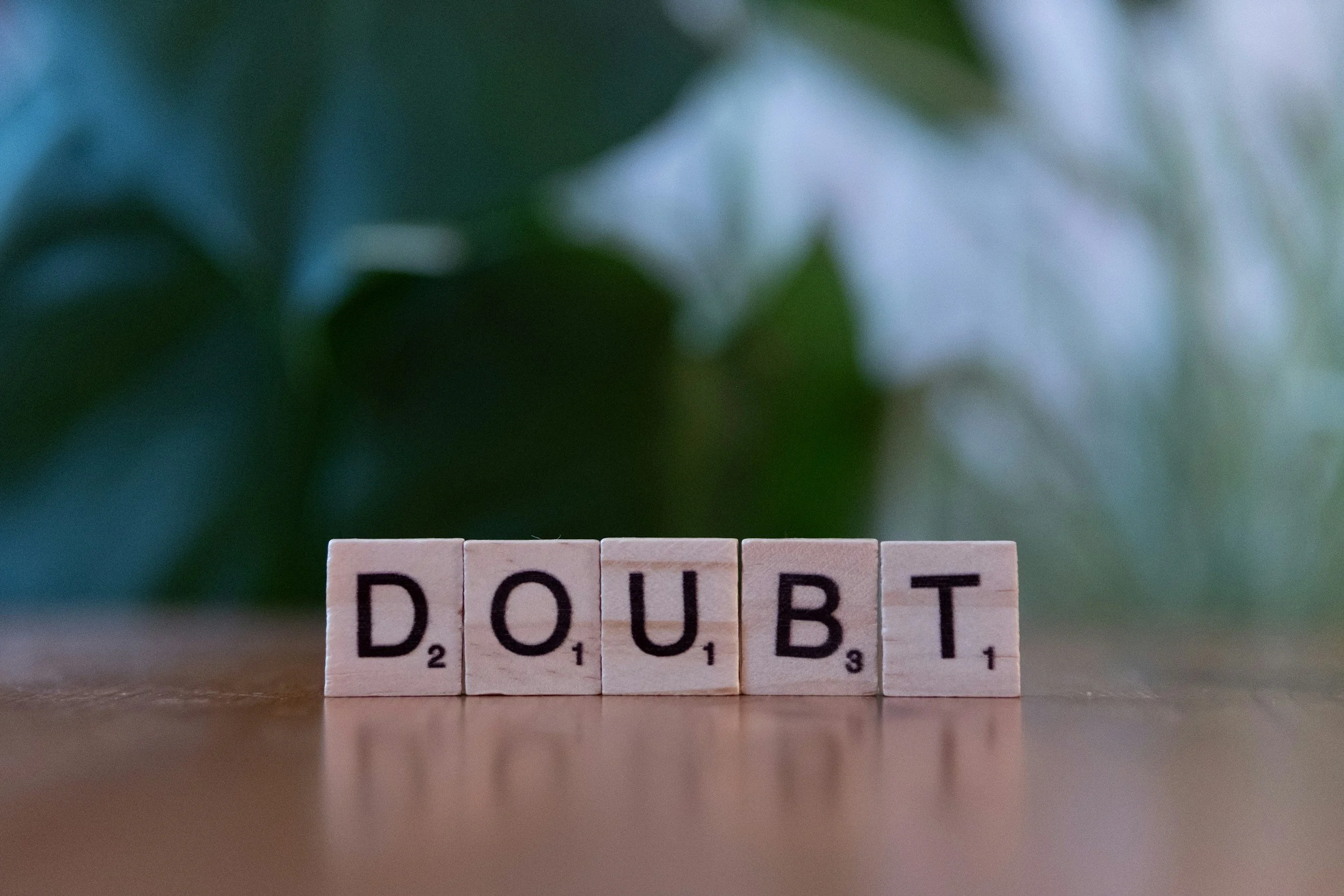
The voice you're trying to silence might be your guide….
A past client writes to me they've been working hard. They've built something that functions a project that pays the bills, things are steadier than they were a year ago. And yet…..
And yet, they're tired. The work no longer fits the way it used to. They mention, that they know this isn't sustainable — that they need to evolve, to find another path, to try something else. But they don't yet know what. So they keep going. They keep producing. They keep waiting for clarity to arrive like a package at the door.
If you recognize yourself in any of this, you're in good company. And I want to offer you a reframe that I use in my coaching practice.
Self-doubt is not the problem
We've been taught to treat self-doubt as an enemy. Something to silence with positive affirmations and productivity hints. But in my work with leaders, professionals, and people living moments of transition, I've come to see self-doubt very differently.
Self-doubt is a messenger.
It shows up precisely at the edge of growth — at the threshold between the person you've been and the person you're becoming.
It is the felt experience of standing at a crossroads and knowing that the old map no longer applies.
The problem isn't that we doubt ourselves. The problem is that we mistake the doubt for a verdict, when it's actually a question.
Is there a difference between doubt and self-sabotage?
Here is where the distinction matters.
Self-doubt, in its healthy form, can be considered a pause. It asks: Is this still right for me? Am I in alignment? What am I not seeing? It slows us down so we can listen. It is, in the best sense, the psyche's way of protecting us from moving too fast in a direction that isn't ours.
Self-sabotage is what happens when we can't tolerate the discomfort of that pause. Instead of listening to the doubt, we act around it. We stay too long in situations that no longer fit, because leaving feels too uncertain. We overwork in the current role rather than face the question underneath. We tell ourselves we'll figure it out "once things calm down," knowing well things never quite calm down. We wait for permission, for certainty, for a sign ……,.
Self-sabotage is not a weakness. It is a human response to the discomfort of not-knowing. But it comes at a cost: the longer we outsource the answer to circumstances, the more we lose contact with our internal compass.
The productive discomfort of "I don't know yet"
One of the most courageous sentences I hear from clients is also one of the simplest: I don't know yet.
A genuine, spacious I don't know yet — held with curiosity rather than fear.
This sentence is a doorway.
It says: something in me knows that the current formula is not the destination, only a stage. It says: I am willing to sit at the edge without forcing an answer.
It says: the void I feel is not empty — it is a space in the process of taking shape.
Most people cannot stay in this sentence for long. It is uncomfortable. Our culture rewards decisiveness and punishes ambiguity. But the clients I've watched build the most meaningful next chapters are almost always the ones who learned to inhabit "I don't know yet" as a workshop, not a waiting room.
Four questions to ask when doubt shows up
If you're in this space , I want to offer you the questions I often bring to my sessions. They are not designed to give you an answer. They are designed to help you hear yourself.
In everything I'm doing right now, when do I feel most alive, most myself?
Not most successful. Not most productive. Most alive. Track those moments over a week. They are data.
2. What am I actually being nourished by in my current work — and what am I only tolerating?
The activity you do and the need it meets are two different things.
3. If I removed the question of money for one hour, what would I naturally move toward?
This isn't a plan. It's a compass check. The direction you drift when the pressure lifts tells you something…
4. What do I never want to experience again in my next chapter?
Sometimes we can name what we're moving away from before we can name what we're moving toward.
Believing in yourself is a practice
The people I coach who make it through transitions are not the ones who felt confident. They are the ones who acted with care even while doubting.
They are the ones who treated their doubt as a companion rather than a critic.
If you are in this space right now — if you are tired, if you can feel that the current shape of your life is not the final shape, if you don't yet know what comes next — please hear this:
You are becoming.
The path is not visible yet, it is forming under your feet.
